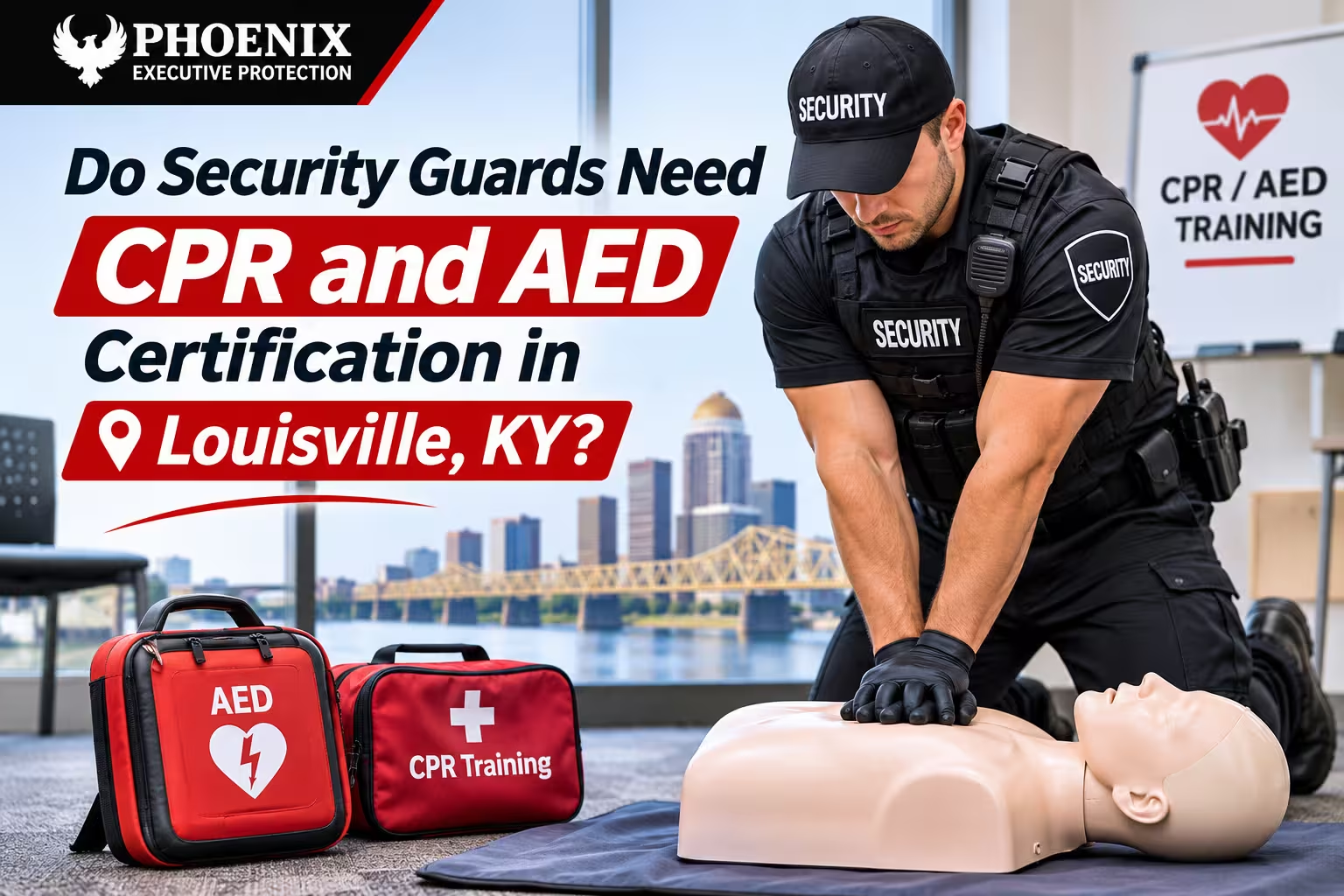
A separate CPR/AED certification isn’t an automatic requirement for every private security guard in Louisville. Neither Louisville Metro’s code nor Kentucky’s workplace first-aid rule makes that card a blanket condition of the job. Your employer, your post, and the safety rules covering that workplace decide whether you need one. Louisville Metro’s armed-security course lists first aid as a required subject, but it stops short of demanding a standalone CPR/AED card for every armed guard. Plenty of employers still ask for one, and CPR training for security guards pays off on any post where people gather. This guide separates the law from employer rules so you know which training to get.
Are CPR and AED Certifications Legally Required for Security Guards in Louisville?
Licensing rules and medical credentials are two different things. An armed-security course shows you met the training standard for that role, while a CPR/AED card shows you passed one course from one provider. Guards who mix them up often assume they’re covered when an employer expects something else.
What Louisville Metro’s Armed-Security Training Curriculum Includes
Louisville Metro Code Section 124.08 spells out the subjects an armed-security training course must cover. “First aid and special problems” appears on that list as a required subject. Anyone researching Kentucky armed-security training requirements should expect first aid to show up as classroom content. The section never mentions CPR or AED use and doesn’t call for a separate certification card. Ask your employer which rule applies to your specific assignment.
How Workplace First-Aid Rules Apply
Kentucky’s workplace regulation 803 KAR 2:310 adopts the Occupational Safety and Health Administration’s first-aid rules in 29 CFR 1910. Subpart K. Under OSHA’s general-industry standard, an employer must have someone adequately trained in first aid when no clinic or hospital sits in near proximity to the workplace. OSHA recommends CPR as part of a workplace first-aid program but doesn’t require it under that general rule. A few industry-specific standards, like the one for commercial diving, do require CPR training. None of these rules create a universal CPR/AED card requirement for every guard.
When Might an Employer Require CPR Training for Security Guards?
Employers set their own bar, and many set it higher than the law does. A security company can make security guard CPR certification a hiring condition because its clients or its posts call for it. That rule binds you as its employee, but it isn’t a statewide legal requirement.
Client contracts drive many of these employer certification requirements. A hospital or event venue may write CPR and AED expectations into its agreement with the security company. Busy public-facing posts like malls and arenas often carry the same expectation. Specialized posts may add AED training for security officers because the site keeps a defibrillator on the wall.
Some employers accept only American Heart Association or American Red Cross courses, while others insist on a specific course level.
| Check the Requirement Before EnrollingAsk your employer which course and certification level it accepts before you pay for CPR or AED training. A generic card from the wrong provider may not satisfy your post’s requirement. |
What Medical Emergencies Might Security Officers Encounter?
Security officers tend to be the first trained adults to notice that someone is in trouble. Because you walk the floor and answer the radio, you’re often closer to a sudden collapse than anyone else on the property.
Picture a shopper who collapses in a store checkout line. You might find a man slumped and unresponsive in a parking garage stairwell. A concertgoer could start choking on food or struggle to breathe. An attendee might trip on the bleachers during a game and hit their head.
Cardiac emergency recognition means spotting the key signs fast: a person who collapses, doesn’t respond, and isn’t breathing normally. AED familiarization means knowing where the nearest device hangs and how to get it open. Your job isn’t to diagnose anyone but to recognize trouble and start the response.
What Should a Security Officer Do During a Medical Emergency?
Your training sets the limits of what you do, and your site’s emergency plan sets the order. Stay inside your level of competence, since paramedics and doctors provide the actual medical care. Your role is to buy time and clear the way for them.
Most medical emergency response follows a similar path. Recognize the signs and activate your site’s emergency procedure. Call 911 or confirm that someone already has, because emergency services activation can’t wait. Start CPR or bring the AED only if you’re trained and the situation calls for it.
Then control the space by keeping doors and elevators clear for the ambulance crew. Send a coworker to meet Emergency Medical Services at the entrance and lead them straight to the person. Once the scene settles, finish the incident report while the details are fresh.
Which CPR and AED Certification Should Security Guards Choose?
The right course depends on what your employer accepts and what your post demands. Three options cover most emergency response training for guards.
Heartsaver CPR AED for Non-Medical Personnel
The American Heart Association designed the Heartsaver CPR AED for people with little or no medical training who need a course card for work. It teaches adult CPR and AED use along with how to tell when someone needs CPR. The AHA offers it in classroom and self-guided formats, plus a blended version that ends with a hands-on skills session. Comparing local American Heart Association training options can help you choose a format, but confirm your employer accepts Heartsaver first.
First Aid, CPR, and AED Training
Guards on large sites often handle far more than cardiac calls. Security officer first aid training adds bleeding control and injury care to the CPR and AED skills. That combined course fits officers who serve as the first responder for an entire building.
When Is Basic Life Support Appropriate?
Basic Life Support is a professional-level course built mainly for healthcare providers. Most security officers will never need it, so take BLS only when your employer or client specifically asks for that credential.
| Training option | Main focus | Potential audience |
| Heartsaver CPR AED | CPR and AED response | Security officers and other non-medical personnel |
| First Aid, CPR, AED | First aid plus CPR and AED | Guards with broader workplace response duties |
| BLS | Basic life support skills | Roles whose employer specifically requires BLS |
How Should Security Officers Maintain Their CPR/AED Certification Records?
Proof matters as much as the training itself. An employer can’t verify a card you can’t find, and an expired card may not count at a new post.
Keep a digital copy of your course completion card along with a printed one. Write down the exact course name and the training provider, then check both the completion and expiration dates. Hold onto any practical skills assessment record if your course included one. Hiring managers may ask for all of it during employer verification.
Renewal timing varies by provider, and AHA Heartsaver CPR AED course completion cards stay valid for two years. Other providers may set a different period, so check yours and book your renewal class early.
How Can Security Guard Candidates Confirm Which Training They Need?
Don’t pay for a class until you know it counts. A course that satisfies one employer can fall short for another.
- Review the job posting for CPR, AED, or first-aid requirements.
- Ask the employer which certification providers and course levels it accepts.
- Confirm whether practical skills testing is required.
- Check the credential’s validity period and renewal expectations.
- Keep the completion card available for employer verification.
Keep one more distinction straight. Armed-security licensing covers the city’s rules for that role, while CPR and AED training usually comes as a separate request from your employer or its client.
Frequently Asked Questions
Do Unarmed Security Guards Need CPR and AED Certification in Louisville?
It depends on your employer, your assignment, and the workplace rules that apply. Unarmed status doesn’t erase training expectations, since front desks and event gates can carry the same CPR/AED requirement as an armed post.
Is an Online CPR Course Enough for a Security Guard?
Not always, because some online options require a hands-on skills session or assessment before you receive a recognized course completion card. Confirm what your employer accepts before you enroll.
How Long Does CPR and AED Certification Last?
Validity depends on the provider and the course, and an AHA Heartsaver CPR AED card stays valid for two years. Check your own card for its exact expiration date.
Final Thoughts
Louisville’s armed-security course lists first aid, yet no blanket rule requires every guard to carry a separate CPR/AED card. Your employer and assignment usually decide that, so confirm the accepted course before you pay. Phoenix Executive Protection LLC offers CPR and AED training in Louisville, KY, including American Heart Association and American Red Cross options, plus first-aid courses. Explore the training options or reach out to ask which course fits your post.