A packed Lexington venue has its own energy. Feeling that energy is the entire point of a sold-out night at Rupp Arena or a sprawling community festival at Masterson Station Park. But behind every smooth event experience is a layer of operational decisions that most attendees never see. Gates have to be positioned correctly. Queues have to move. Emergency exits have to be clear, staffed, and functional from the first ticket scan to the last person out.
This article gives event organizers and festival producers a concrete understanding of how crowd flow planning works in practice. It covers what festival security planning actually involves before opening day, and why event queue management is one of the most consequential decisions you will make for any large event.
If you are planning a concert or outdoor festival, this is the resource for crowd management in Lexington KY. Concert event safety depends on getting these fundamentals right — not just hoping your team figures it out at the gate.
When Crowd Management Fails, Everything Fails
In November 2021, Ten people died and hundreds were injured at the Astroworld Festival in Houston. Investigations pointed to a combination of underprepared gates and no meaningful mechanism to slow the crowd surge building at the front of the stage. The event had security personnel on-site. What it lacked was a functional crowd management system.
That failure is not unique to Texas. Lexington’s live event calendar has grown steadily over the past several years. Venues like Rupp Arena host high-capacity shows that draw regional audiences. Outdoor events at Masterson Station Park and along the festival circuits in central Kentucky regularly draw thousands.
Most dangerous situations at Lexington events develop from a small number of recurring structural failures:
- Undertrained gate staff: Officers who lack crowd behavior training can slow entry to dangerous levels, causing pressure to build outside before the event even begins.
- Queue blind spots: Unmonitored queue lines along building walls or in narrow corridors create the exact bottleneck conditions that precede crowd surges.
- Blocked or unmarked emergency exits: Exit doors that are propped shut, obstructed by equipment, or missing visible signage fail the first test of any safety inspection — and the last test of a real emergency.
What Festival Security Planning Actually Covers
Security at a live event is a layered operational system covering entry, circulation, crowd density, emergency preparedness, and inter-agency coordination. Understanding what goes into that system is the starting point for building one that works.
Risk Assessment Before the First Barrier Goes Up
Effective festival security planning in Lexington begins weeks before gates open. A formal risk assessment covers expected attendance figures, venue layout vulnerabilities, time-of-day crowd patterns, weather exposure, and alcohol service zones. You also need to understand the coordination requirements with the Lexington Division of Fire and the Lexington Police Department (LFUCG). This phase is where organizers identify what could go wrong before committing to a gate layout or barrier plan.
Bringing a security contractor into this phase has a specific operational value. A contractor’s pre-event venue inspection often surfaces structural risks that organizers miss entirely: squeeze points between temporary structures, poor lighting near exit pathways, fencing configurations that look fine on a map but create pressure points under load. Identifying those issues during planning costs far less than managing them on event day.
Proactive Management vs. Reactive Control
Crowd management and crowd control are not the same thing. Management is the proactive work that involves spacing queue lanes and positioning staff at the right intervals before problems develop. Control is what becomes necessary when the management layer fails: physical intervention, barrier repositioning under pressure, emergency response. Good festival security planning is built around management.
Gate Strategy Is Your First and Most Critical Decision
The gate is where crowd flow planning either succeeds or collapses before the event is one hour old. Every decision made at the entry point — lane count, staffing, technology, and screening setup — determines whether your attendees enter smoothly or whether pressure builds outside.
Calculating Gate Capacity for Lexington-Area Venues
The most dangerous overcrowding at concerts and festivals happens in the 45-minute window before a headliner takes the stage. That is when a large share of ticket holders arrive simultaneously, often after traffic and parking delays. Gate math built for average arrival loads will fail at peak load.
For large event crowd planning in Lexington, design your entry capacity around the worst realistic arrival scenario, not the median one. If 40% of your audience arrives in the same 30-minute window, your lanes have to process that volume without backing the queue into the street.
Ticketing and Admission Technology That Keeps Lines Moving
Modern ticketing verification — QR code scanning, NFC wristbands, multi-gate real-time sync platforms — reduces friction significantly when implemented correctly. The technology itself matters less than how it’s deployed. A poorly staffed QR scanner creates the same bottleneck as a paper ticket tear. Lane design and staff training are the real variables in event queue management. The technology is only as fast as the person operating it and the lane it’s placed in.
Common admission technology in use at mid-to-large Lexington events includes:
- QR code scanning via handheld devices or smartphone apps processes most general admission entries in under three seconds per person.
- NFC wristbands eliminate rescan fraud and allow real-time occupancy tracking across multiple entry points.
- Multi-gate sync platforms push a used-ticket flag instantly across all entry lanes, closing the window for duplicate entry attempts.
- Live attendance dashboards alert operations supervisors when a specific gate is processing above its designed throughput capacity.
Bag Search and Screening Without Choking Entry Flow
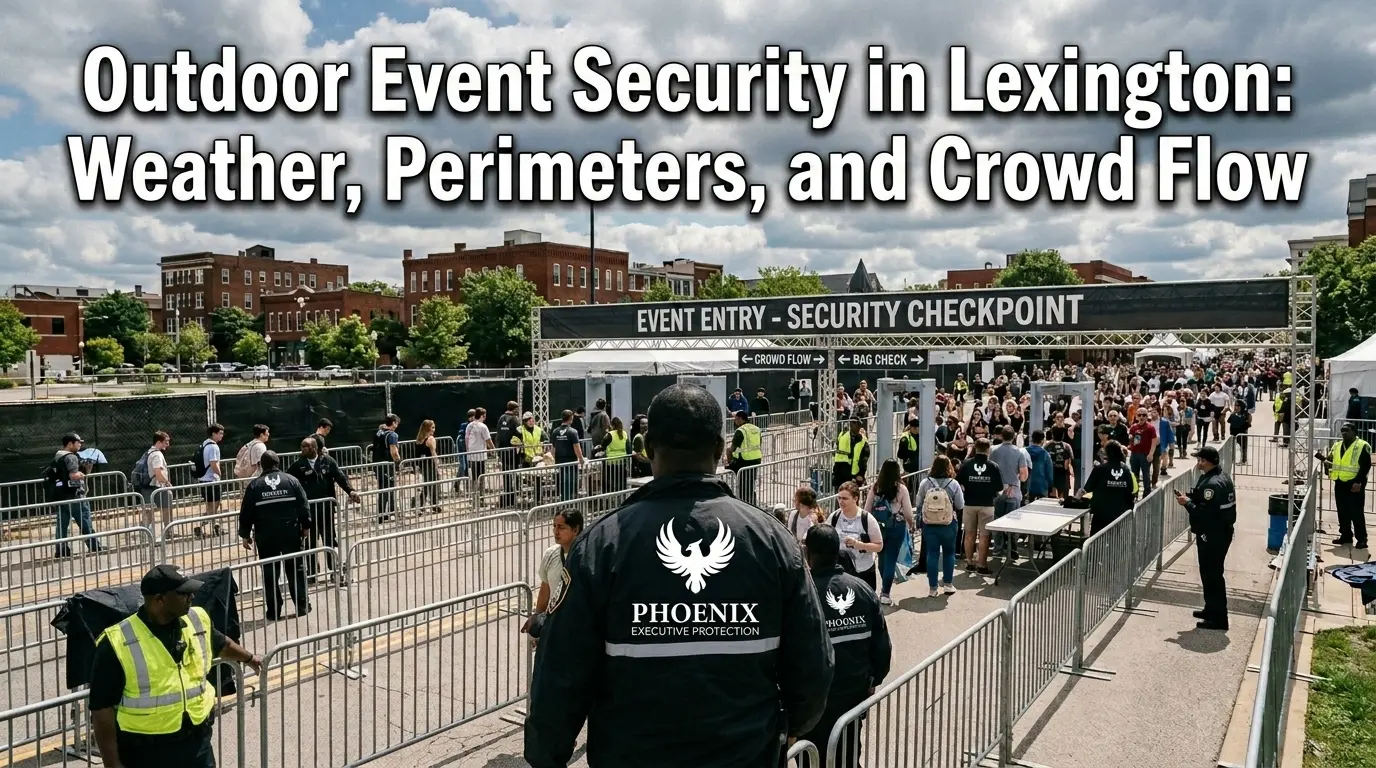
Prohibited item screening through bag checks or walk-through sensor portals is a standard requirement at most Lexington concerts and festivals. The critical principle: screening lanes must be physically separated from ticket verification lanes. Both functions should not share the same choke point.
This is one of the most common structural errors in concert event safety planning, and it’s entirely preventable with proper lane design. Run verification in one lane, screening in the adjacent lane, and assign dedicated staff to each function.
Queue Design — Managing the Space Between Arrival and Entry
A well-designed gate means nothing if the queue leading to it becomes a pressure point.
How to Design Queue Lines That Don’t Create Pressure Points
Improperly designed queue lanes, especially those running parallel to walls, fences, or fixed barriers, are inherently risky. Switchback queue lanes with regular exit break points allow attendees to leave the line without disrupting others. This design also makes it easier for staff to monitor the full queue body from a single position.
Barrier placement within queue zones serves two purposes: directing flow and absorbing lateral crowd pressure. Barrier feet should be flat and wide to prevent tipping under load. Barriers forming 90-degree corners without padding create injury risk if a crowd surge reaches them. Every corner in a queued crowd is a potential compression point — plan barrier layouts with that in mind.
Signage, Lighting, and Staff Positioning in Queue Areas
Guards and stewards should be positioned at the head, middle, and rear of any queue longer than 150 persons. Signage must identify which queue serves which gate or ticket tier clearly — general admission lines that merge with VIP entry lanes are a recurring source of crowd frustration and minor incidents that escalate quickly. For evening festivals in Lexington, poorly lit queues require temporary lighting stakes along the line perimeter.
Staff roles within the queue zone break down into three distinct positions:
- Queue Entry Monitor: Positioned at the tail of the line, this officer watches for uncontrolled crowd growth and signals the gate supervisor when the queue approaches its designed maximum length. Early warning from this position prevents the line from extending into uncontrolled pedestrian traffic areas.
- Mid-Line Steward: Moves through the queue, answers questions, and identifies early signs of frustration or crowding before either escalates. This role is as much about crowd behavior as it is about crowd safety — people who feel managed are less likely to push.
- Gate Threshold Officer: Manages the handoff between queue and entry scanning, ensuring the lane never backs up into the queue body due to a verification delay. This is the highest-throughput position at the gate and requires someone with strong situational awareness.
Emergency Exit Planning Lexington Organizers Can’t Afford to Miss
Emergency egress is the area where minimum compliance and actual operational readiness diverge the furthest. Understanding that gap and closing it before doors open is a core responsibility of your event security team.
What Lexington Fire Code Requires (And What It Doesn’t Tell You)
Local fire code compliance is coordinated through the Lexington Fire Department and is required as part of any public event permit in Fayette County. It establishes the minimum standard for emergency egress. Exits must be clearly marked, unobstructed, and illuminated throughout the event.
But meeting the minimum on a walkthrough inspection is not the same as being operationally ready. A door that passes a code check can still be functionally useless in a crowd emergency if no trained staff member is assigned to open it immediately.
The pre-event inspection is the last line of defense before doors open. Security personnel should physically walk every emergency exit pathway and confirm nothing has shifted since the initial venue assessment. Equipment cases, food vendor carts, and temporary staging migrate into egress paths between setup and event time with regularity.
Emergency Exit Staffing and Crowd Behavior at Exit Points
A guard who is positioned close to an exit is not the same as a guard who is assigned to it and briefed on its operational protocol. A dedicated guard is empowered to open the exit without waiting for radio confirmation from a supervisor. In a crowd emergency, that distinction is the difference between seconds and minutes. Assign specific officers to specific exits. Brief them on the protocol. Make opening the door their explicit responsibility.
Every event needs a documented Emergency Response Plan (ERP):
- The ERP should be finalized with event security leadership, venue management, and the Lexington Division of Fire before the event permit is approved.
- Every security officer on site — not just supervisors — should be briefed on their specific role in the ERP, including which exit they are assigned to and where the assembly point is located.
- Communication protocols between gate officers, exit officers, and the central command post should be tested during the pre-event walkthrough, not assumed to work on the night.
- Exit doors must remain operable throughout the event — never chained, padlocked, or held shut by equipment — regardless of whether the event is at 30% or 100% capacity.
Staffing Ratios and Deployment for Concerts and Festivals in Lexington
The standard baseline is one trained security officer per 100 attendees at a general-admission event without alcohol service. That baseline almost never applies cleanly to a real Lexington event. Alcohol service, nighttime hours, and outdoor venues with multiple entry points all push the ratio upward. Festival crowd management and concert crowd management in Lexington both require organizers to apply those variables honestly.
Adjusting Staffing for Lexington-Specific Variables
The variables that move your staffing ratio beyond the baseline:
- Alcohol service areas: Bar and beverage areas require dedicated licensed officers trained in conflict de-escalation and early identification of intoxication. The ratio in these zones should tighten to one officer per 50 to 75 persons during peak service hours.
- General admission floor sections: Unreserved standing areas concentrate crowd density in unpredictable ways, especially as performances begin. Officers should be stationed along the barrier between the audience and the stage, with floating staff at the rear and sides.
- Multi-stage or multi-zone festivals: Events with simultaneous programming across multiple stages require independent staffing plans for each zone, not a single ratio applied to total attendance. Transition corridors between zones carry their own risk and need dedicated coverage.
- Evening and late-night events: Low-light conditions reduce a crowd’s ability to self-navigate, increasing reliance on staff for direction. Lighting and visible staff presence both become more critical after dark.
The Command Structure That Holds It Together
Guard ratios mean nothing without a clear command hierarchy. A well-run Lexington event security operation functions with a central command post staffed by a site supervisor who maintains radio contact with all zone leads. Zone leads own specific areas, like gates, queues, and emergency exits. Line officers execute and escalate within those zones. The supervisor’s job is to monitor the full operational picture and redeploy resources before pressure turns into a problem.
Frequently Asked Questions About Crowd Management in Lexington
How far in advance should I hire event security for a Lexington concert or festival?
Bring your security provider in no later than 45 to 60 days before the event, ideally during the venue selection phase. The earlier a security contractor joins the planning process, the more influence they have over gate placement, barrier design, and emergency exit configuration.
How many security guards does a Lexington outdoor festival typically require?
The baseline for large event crowd planning in Lexington is approximately one guard per 100 attendees for a standard daytime event. That ratio tightens significantly for nighttime events, events serving alcohol, and events with general admission floor sections — in those contexts, staffing can approach one guard per 50 attendees in the highest-risk zones.
Are emergency exits required to be staffed during a Lexington concert?
Yes — and the requirement goes beyond simply having exits unlocked and marked. The Lexington Division of Fire and venue permit conditions typically require clear egress pathways throughout the event. Having a trained officer assigned to each exit, briefed and empowered to act immediately, is what makes that requirement functional rather than just documented.
What role does the Lexington Police Department play in festival security planning?
For public festivals on city property or events exceeding certain attendance thresholds, coordination with LPD becomes a permit requirement. A local security provider with an existing LPD relationship can help organizers understand exactly what coordination is required and facilitate that communication directly.
Work With a Security Team That Knows Lexington Events
For planning a concert or festival in Lexington, you need a security team that understands the venues, the permitting process, and the specific crowd dynamics of the central Kentucky events. Phoenix Executive Protection LLC brings field-tested event security experience and veteran-led staff that handles crowd flow, gate strategy, and emergency preparedness. Contact Phoenix Executive Protection to start a conversation about what your event actually needs.