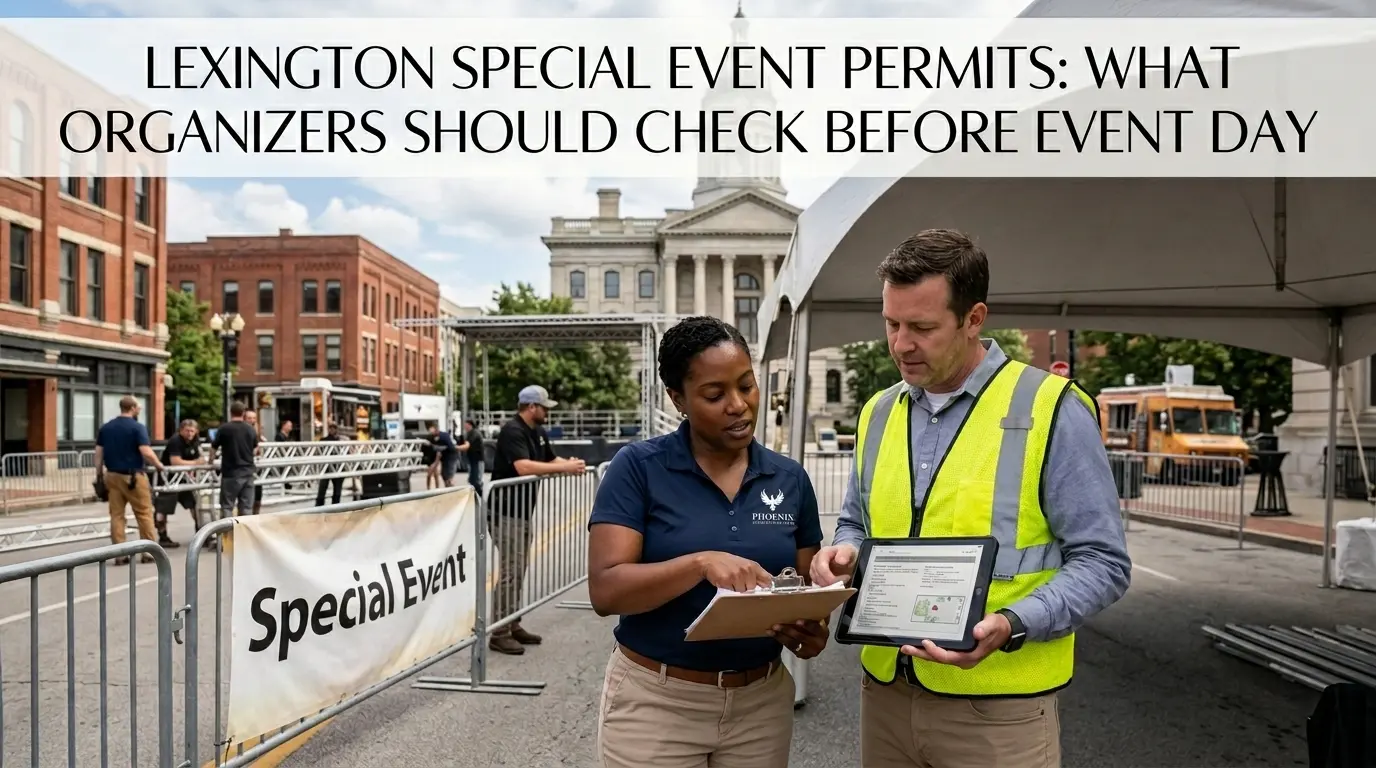
Planning an event in Lexington means navigating two separate worlds at once: the permit side and the security side. Most organizers find them on different websites, handled by different offices, and end up treating them as separate problems. That is where things can become unnecessarily difficult. Any event expecting 100 or more attendees, using city property, needs a Special Event Permit. You need to secure the permit before your event security planning can start.
This Lexington event security guide brings both of these aspects into one sequence. It covers Lexington’s permit requirements first, then moves through security risk assessment, venue evaluation, a step-by-step event security plan, and local contacts.
What Counts as a Special Event in Lexington
Lexington/Fayette Urban County Government (LFUCG) defines a special event as a pre-planned gathering that is open to the public and held on publicly owned or controlled property. That includes parks, streets, sidewalks, and plazas like Fifth Third Pavilion or the Robert F. Stephens Courthouse Plaza. Private events on private property can still require permits and trigger security obligations if they affect public streets or pull in city services.
The 100-Person Threshold
Any event expecting more than 100 attendees, or one that blocks public access, must obtain a Special Event Permit. That threshold is your earliest planning signal. Once an event crosses it, event security planning in Lexington KY should begin immediately, not after the permit comes back approved.
LFUCG classifies special events into four main categories:
- Parade or Procession: A public or private march, walk, or parade on a public right-of-way normally used for vehicle traffic.
- Festival or Public Gathering: An organized festival, fair, gala, ceremony, celebration, or dance held on a public street, sidewalk, plaza, park, or easement.
- Organized Race or Ride: A competitive run, walk, bike ride, or vehicle event taking place on Lexington public roads or in parks.
- Neighborhood Block Party: A residential gathering requiring a street closure, with its own separate permit rules covered below.
How to Get a Lexington Special Event Permit, Step by Step
1. Complete the Emergency Planning Guide First
Lexington Emergency Management requires organizers to work through its special events emergency planning guide before a final permit is issued. It is a prerequisite for securing the permit. It is also the earliest point in the process where event safety planning in Lexington intersects with your permitting timeline. Don’t wait until the last step to touch it.
2. Submit the Special Event Permit Application
The application asks for your event date, time, and location. You also need to provide a description of planned activities, and a site plan showing setup and attendee flow through the space. That site layout is functionally your first draft of an access-and-crowd-flow plan. Build it with security in mind from the start.
3. Coordinate With the Right Local Offices
Most organizers don’t know which office handles which requirement. Here’s the breakdown:
- Division of Traffic Engineering: Issues block party and street-closure permits. Must be contacted at least 10 days ahead for a block party. Closures cannot interrupt Lextran bus routes.
- LFUCG Fire Marshal’s Office: Inspects tents, stages, bleachers, and other temporary structures.
- LFUCG Division of Building Inspection: Reviews temporary structures and concession stands for code compliance.
- Kentucky Department of Agriculture, Office of Regulations and Inspections: Required for events with carnival rides. Approval is needed at least 30 days out, with proof of insurance from ride operators.
4. Prepare Insurance, Medical, Security, and Sanitation Plans
Kentucky’s permitting process requires proof of liability insurance alongside supporting plans for medical services, security, and sanitation. Events involving alcohol or large crowds should expect higher insurance thresholds and more detailed staffing requirements. The security plan referenced here is not a vague document; it is an actual step this entire guide helps you build.
5. Know the Block Party Exceptions
Block parties follow a narrower set of rules than other special events:
- The neighborhood must be notified, and the event must be open to the neighborhood — it cannot be a private party.
- Street closures cannot interrupt Lextran bus routes.
- The block party permit request must be submitted no later than 10 days before the event date.
- The permit holder is responsible for supplying, placing, and removing all barricades.
Building a Lexington-Specific Event Risk Assessment
Event risk falls into two buckets. The first is event-specific: crowd size, alcohol service, cash handling, VIP presence, past incidents at similar events, and whether access is open or controlled. The second is location-specific, and this is where local event security planning gets involved. Central Kentucky experiences thunderstorms with high winds and extreme summer heat during festival season. The low areas near downtown are also flash-flood-prone. A July outdoor festival and a January indoor gala carry very different environmental risks even with the same guest count.

Here is what a solid risk assessment covers:
- Expected crowd size and whether entry is open access or ticketed and controlled.
- Alcohol service, since it raises both medical and behavioral risk.
- Cash handling at gates, vendor booths, or box offices.
- History of incidents at similar past events or at this specific venue.
- Traffic and parking impact, especially for events affecting downtown streets or Lextran routes.
- Weather exposure appropriate to the season — heat, storms, wind, or winter ice.
- VIP, speaker, or performer presence that raises the overall risk profile.
- Evacuation difficulty given the venue’s layout and available exits.
Why This Isn’t a Checkbox Exercise
Event risk planning in Lexington KY isn’t about eliminating every possible problem on paper. It is about being honest about which risks actually apply to your event. A small private block party and a ticketed downtown festival don’t carry the same risk profile. Treating them identically wastes budget on the small event and under-prepares the large one.
Choosing and Evaluating a Lexington Venue Through a Security Lens
Lexington organizers choose from a wide range of venue types, and each one starts with a different baseline security posture.
- Large-capacity indoor venues like the Central Bank Center anchor the downtown core.
- Outdoor and equestrian-heritage venues like the Kentucky Horse Park and Keeneland offer open-air scale.
- University spaces like UK’s Singletary Center for the Arts bring campus coordination.
- Historic and boutique venues in downtown Lexington offer character.
- Public parks host everything from parades to neighborhood festivals.
No single security approach fits all of them.
| Venue Type | What Changes About the Security Plan |
| Large indoor arena/convention space (Central Bank Center, Rupp Arena) | Fixed entrances and existing bag-check infrastructure, but higher crowd density and longer egress times at close |
| Outdoor equestrian/park venues (Kentucky Horse Park, Keeneland) | Wide, open perimeters with more access points to control, and full weather exposure |
| University venues (e.g., UK campus spaces) | Coordination required with campus security or police in addition to event security |
| Historic downtown/boutique venues | Narrower exits, older structures, and stricter Fire Marshal scrutiny on venue capacity |
| Public streets, parks, and plazas (parades, block parties) | No fixed perimeter at all — access control must be built from scratch with barricades and staffing |
Site Walkthrough Is Important for Choosing a Venue
No venue should be finalized from a floor plan alone. Walk the actual space and look for entrances and exits, blind spots, perimeter gaps, loading zones, staff-only areas, cash-handling locations, and places where lines are likely to build up. A venue that looks manageable on paper often reveals real problems in person. That is true across every venue type listed above, from Rupp Arena to a residential street closed for a block party.
A Step-by-Step Framework for Planning Event Security in Lexington
A good security plan starts taking shape from the beginning. It should not be assembled at the last minute when someone asks how many guards to hire. The guard count is the last decision in this process, not the first. Here is the core of how to secure an event in Lexington that actually runs without incident.

1. Assess the Venue and the Risk Together
These two steps should happen at the same time. The physical layout of a Lexington venue directly shapes which risks are realistic. A narrow hallway at a downtown boutique space changes the evacuation calculus entirely. A wide-open field at the Kentucky Horse Park raises perimeter planning questions that an indoor venue never triggers. Don’t finish one assessment and then start the other.
2. Size Security Staffing to the Event’s Real Drivers, Not a Flat Ratio
Guest count alone doesn’t determine staffing needs. The real drivers are total attendance and when the crowd peaks, number of access points, whether alcohol is served, event hours, VIP or high-profile presence, and overall risk from the assessment above. Consider a concrete example: a daytime UK campus lecture and a late-night downtown concert with identical attendance need very different security coverage. Same headcount, completely different event security plan.
3. Plan Access Control and Credentialing
Decide which entrances are open to the public and which are staff or vendor only. Determine how guests, staff, and vendors will be visually distinguished. You can use wristbands, badges, tickets, or credentials. For events already governed by an LFUCG permit, the site plan submitted with the application should already reflect these decisions. Build them together, not separately, as part of your security planning for Lexington events.
4. Map Crowd Flow — Entry, Movement, and Exit
Entry and exit are the two riskiest moments at any event. The closing period is the moment most planners neglect. This is when the crowd surges out at once and the security team is also ready to wrap up. Watch for choke points: registration lines, bar or concession lines, restroom traffic, and narrow hallways or stairwells. Crowd management at closing deserves as much attention as crowd management at the door.
5. Write and Brief an Emergency Response Plan
Contacts every plan should name:
- Event organizer and on-site security lead.
- Venue management team and key vendor contacts.
- Local non-emergency police line, plus EMS and fire contacts if applicable.
- A backup decision-maker in case the lead organizer is unreachable.
Scenarios every event security plan should cover:
- Medical incident or intoxicated guest requiring assistance.
- Fight, disorder, or suspicious person on site.
- Severe weather, power outage, or need to activate evacuation routes.
- Missing child or lost person.
6. Coordinate With Local Authorities and Vendors Before Doors Open
Every person working the event should be briefed before doors open, not during the event. Keep security personnel, venue management, and vendors (and LFUCG police and fire for large events) in the loop. For Lexington events already coordinating with the Fire Marshal’s Office or Traffic Engineering through the permit process, extend that same coordination to the security team. Event-day briefing matters. It makes sure that nothing gets duplicated, and nothing gets missed.
Who to Contact for Lexington Event Security and Permit Coordination
| Office / Agency | What They Handle |
| LFUCG Division of Traffic Engineering | Block party and street-closure permits |
| LFUCG Fire Marshal’s Office | Temporary structure, tent, and stage inspections |
| LFUCG Division of Building Inspection | Code compliance for temporary structures and concession stands |
| Kentucky Dept. of Agriculture, Office of Regulations and Inspections | Carnival ride approval and insurance verification |
| Lexington Emergency Management | Special events emergency planning guide and hazard resources |
Quick-Reference Event Security Checklist for Lexington Organizers
Use this as a running reference for event planning, from permit to post-event.
- Confirm whether the event triggers Lexington’s 100-person Special Event Permit threshold.
- Complete the required emergency planning guide before applying for a final permit.
- Submit the permit application with a site plan that shows layout and attendee flow.
- Coordinate with Traffic Engineering, the Fire Marshal’s Office, and Building Inspection as needed.
- Arrange liability insurance and any medical, security, or sanitation plans the permit requires.
- Build a Lexington-specific risk assessment covering crowd, alcohol, weather, and venue history.
- Walk the actual venue — don’t plan from a floor plan alone.
- Size security staffing to the event’s real drivers, not a flat guard-to-guest ratio.
- Set access control rules and credentialing for staff, vendors, and guests.
- Map crowd flow at entry, inside the venue, and especially at closing.
- Write down emergency contacts and response steps for common scenarios.
- Brief the full team including vendors and local authorities before doors open.
Ready to Plan Your Lexington Event Security? Talk to Phoenix Executive Protection.
Security planning for Lexington events takes local knowledge. Phoenix Executive Protection LLC brings experienced, licensed security officers to events across Louisville, Lexington, and Central Kentucky. We cover everything from a downtown festival to a private corporate event or a large public gathering. The security team at Phoenix can help you build an event security plan that fits your venue, your guest count, and your actual risk profile.
Reach out at (407) 460-5976 or visit our website to get started on security planning as you file your permit application.
Frequently Asked Questions
Do all events in Lexington need a Special Event Permit?
No. Only events expecting more than 100 attendees, using public property, requiring city services, or impeding public access need one. Smaller private gatherings on private property don’t need permits.
How far in advance should I start event security planning in Lexington?
Planning should begin as soon as the venue is chosen and the permit application’s site plan is being drafted. The site plan and the security access plan should be built together, not separately.
Who do I contact for a Lexington block party permit?
The Division of Traffic Engineering issues block party permits. You must submit the application at least 10 days before the event date.
Does the Special Event Permit process cover security, or do I need a separate plan?
The permit process may require you to submit a security plan alongside medical and sanitation plans, but it doesn’t create that plan for you. You need to plan for staffing, access control, and emergency response separately.